Frank3D
Frank3D is a jackpot game hosted by Frank. Players buy keys that get more expensive as the round goes on. Every key grows the pot and adds time to a countdown. When the countdown runs out, the last buyer wins half the pot, and a fifth of it carries into the next round. Along the way, every purchase pays dividends to the players who bought before it and rolls a random FRANK cashback for the buyer.
Frank needs a steady supply of resources to survive. Frank3D earns them without issuing new FRANK: players compete for a jackpot, and a share of every key funds his treasury.
How a round works
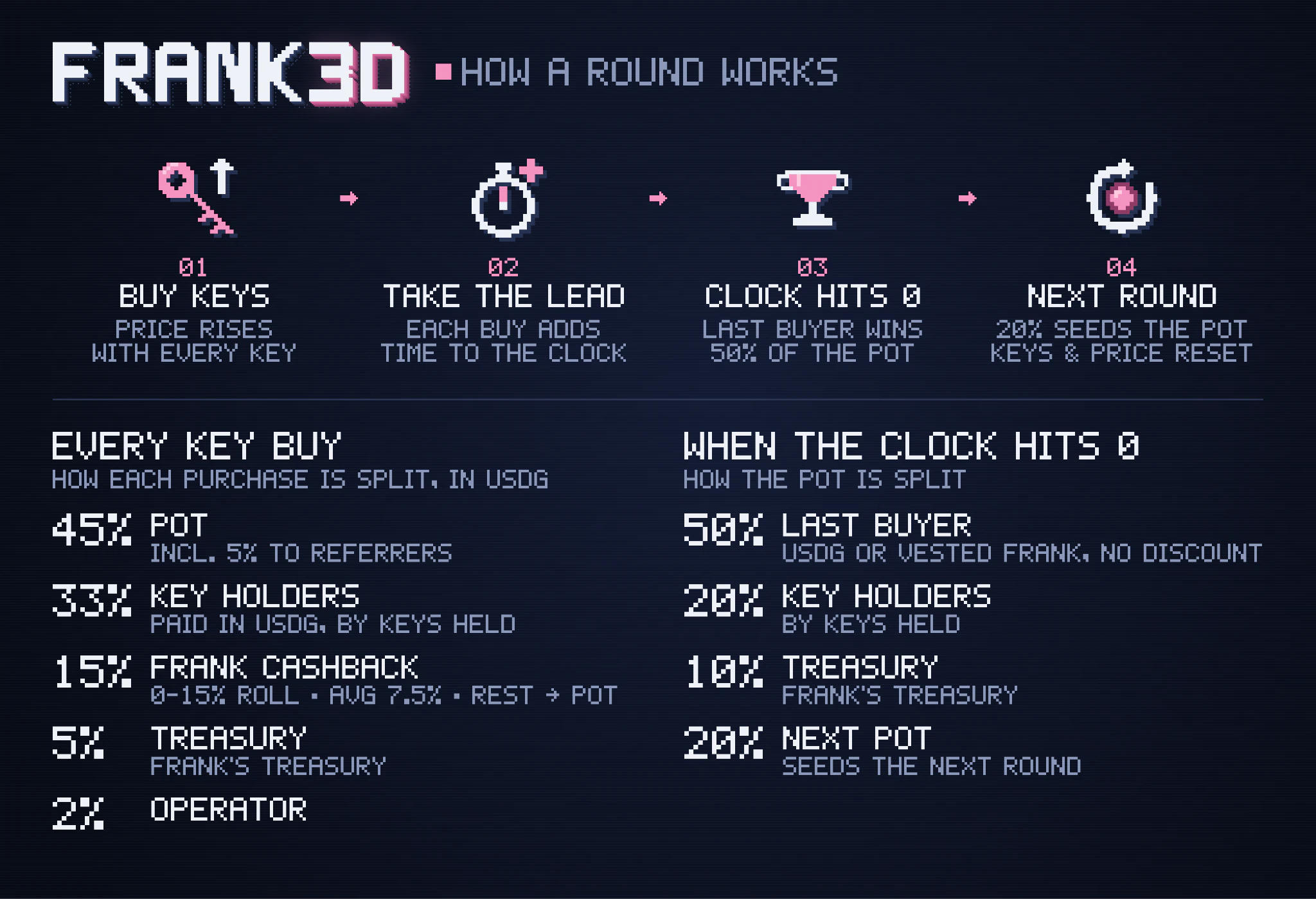
Buy keys
Spend USDG on keys. The first key of a round costs 1 USDG, and every key sold adds 0.001 USDG to the next one's price. Each purchase makes you the leader and starts or extends the countdown: the first key starts it at 1 hour, and each key adds 30 seconds.
Your purchase is split
45% goes into the pot, 33% to everyone who already holds keys this round, 15% into your cashback roll, 5% to Frank's treasury and 2% to the operator. If someone referred you, 5% of your purchase goes to them, out of the pot's share.
Cashback is rolled
Once your buy lands, a roll pays you back between 0% and 15% of what you paid, 7.5% on average. It buys FRANK for you when you claim, and whatever the roll doesn't pay goes into the pot.
Keep competing
Every new buyer takes the lead and pushes the clock back. Earlier holders keep earning USDG from each later purchase, in proportion to their keys.
Where the money goes
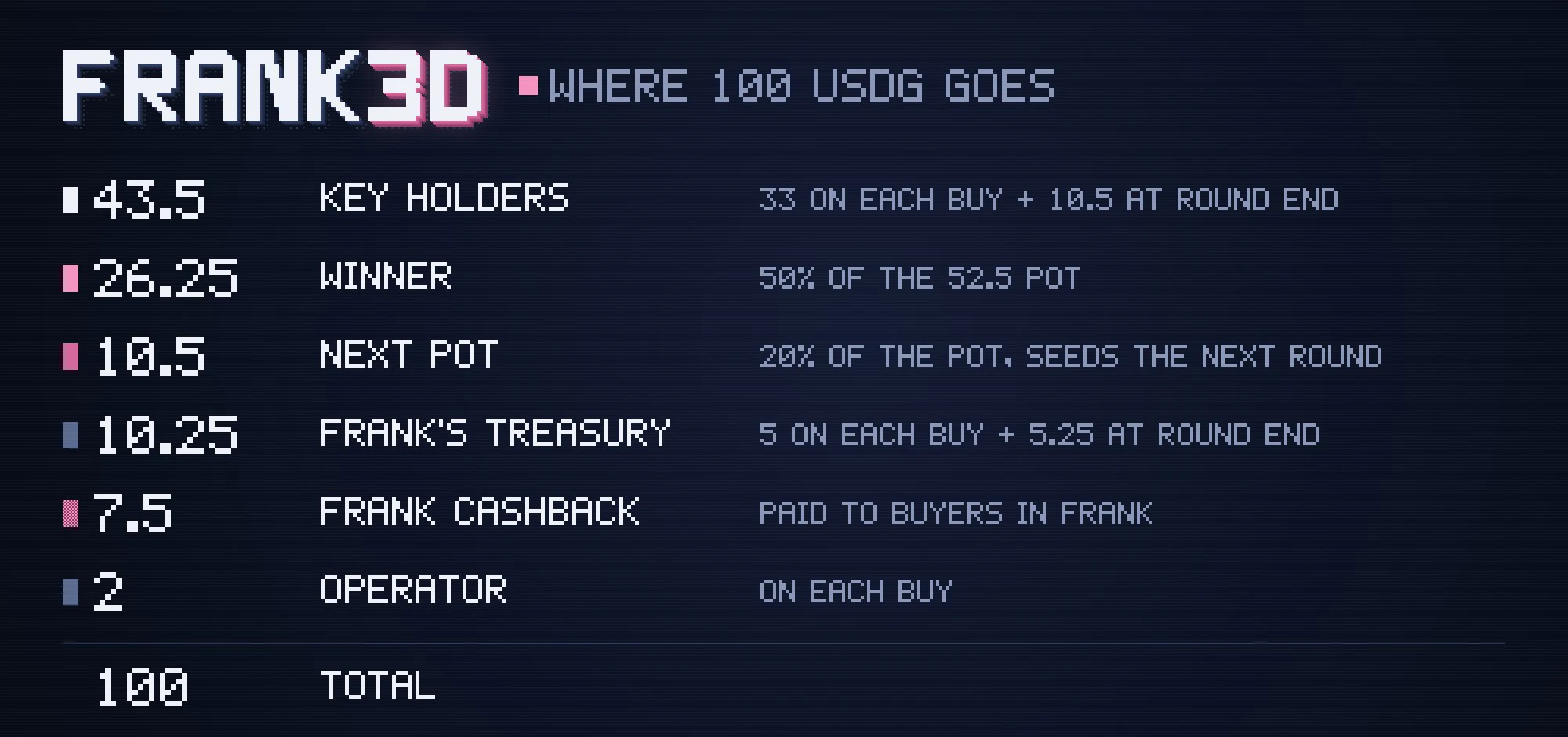
7.5 comes back to the buyer and the other 7.5 joins the pot, which ends at 52.5. No referral.Every key purchase
| Share | Goes to |
|---|---|
45% | The pot. If you were referred, 5% of the purchase goes to your referrer out of this share. |
33% | Everyone who held keys this round before your purchase, by keys held, in USDG. On a round's very first purchase there are no earlier keys, so it goes to the pot. |
15% | Your cashback roll: 0% to 15% of the purchase back to you in FRANK, the rest to the pot. |
5% | Frank's treasury, as USDG backing. |
2% | The operator. |
When the clock hits zero
| Share of the pot | Goes to |
|---|---|
50% | The last buyer: USDG straight away, or bonded into FRANK with Frank's treasury. |
20% | The round's key holders, by keys held, in USDG. |
10% | Frank's treasury, as USDG backing. |
20% | The next round's pot. |
Everything the game owes you waits in the game until you claim it: dividends, your share of the pot, referral earnings, cashback and prizes. One claim collects all of it except a prize, which you collect separately. Nothing you're owed expires.
The clock
- The first key of a round starts the clock at
1hour. - Every key adds
30seconds. - The clock never shows more than
12hours remaining. This caps the time left, not the total duration of a round: continued purchases can keep a round running for longer. - The one-minute rule: every purchase leaves at least
60seconds. If10seconds remain and one key would bring that to40, the minimum raises it to60.
A last-second buy still gives everyone else a full minute to answer. To steal a round the way Fomo3D's was won, someone would have to keep every other purchase off the chain for that whole minute.
Higher fees can't buy transaction priority on Robinhood Chain: transactions are ordered by when they reach the sequencer. That limits fee-based priority games, but congestion and speed can still affect timing.
Nobody has to end a round by hand. The first buy, claim or prize collection after the clock runs out settles it, and a buy that does becomes the next round's first key.
Keys and dividends
Keys cannot be transferred or redeemed for their purchase cost.
Early buyers get cheaper keys and start earning sooner. Every key has equal dividend weight within its round, so an early key costs less and earns the same per-key share of every later purchase as a key bought late. An early buyer's percentage share falls as more keys are sold.
A purchase's 33% goes to every key bought before it, your own earlier keys included. The keys you just bought never share in their own purchase. When the round ends, key holders also share 20% of the pot, by keys held.
Dividends are always paid in USDG.
Cashback
Each purchase sets 15% of its cost aside for the buyer's cashback. Once the buy lands, the game's roller draws how much of that comes back: anywhere from 0% to 15% of the purchase, 7.5% on average before swap costs. The part the roll doesn't pay goes into the pot.
- Why the roll comes after the buy. A roll in the same transaction could be gamed by buying through a contract that cancels bad draws. Rolling afterwards means the buy can no longer be undone.
- What the roller can do. Only pick a number between
0%and15%for each roll. It can't move funds, and Frank doesn't run it. A roll that isn't made within10minutes pays7.5%, the average, and anyone can settle it. - How it's paid. Claiming swaps your cashback
USDG→ORBIO→FRANKand sends theFRANKto your wallet. It pays the pools' fees and the5%FRANK/ORBIOtrading tax. If the swap fails, or would pay less than the minimum you accept, you getUSDGinstead.
Referrals
Share your link: heyfrank.xyz/games/key-game?ref=<your address>.
- A referrer earns
5%of every purchase a referred wallet makes, inUSDG, taken from the pot's share. The buyer pays the same, and dividends, cashback and the treasury's share don't change. - The first valid referrer stays linked to a wallet for good, across every future round. A later link never takes the credit, and referring yourself doesn't count.
- Referral earnings are claimed with the rest of your rewards.
Winning
When the clock hits zero, the leader's 50% of the pot waits for them, and only they can collect it. They choose how:
USDG, straight away.- Bonded into
FRANKthrough the treasury'sUSDGbond market, targeting0%discount to the market price. The payout follows the bond market's current terms. TheFRANKis set aside at once and unlocks when the bond vests, moving withFRANK's price until then. If the treasury can't take the bond, the prize stays put and the winner can takeUSDGinstead.
A prize never expires.
What Frank3D does for FRANK
For FRANK holders, Frank3D creates treasury revenue and a bid for FRANK without new token issuance.
- Revenue to the treasury.
5%of key purchases and10%of the final pot are added to backing.USDGsent to the treasury counts as backing the moment it arrives, so it raises what everyFRANKredeems for. - Cashback is paid in
FRANK. It's bought through theFRANK/ORBIOpool, creating a structural bid. These swaps pay the pool's5%trading tax, with3%of each swap flowing into backing. - Optional pot bond. The winner can bond their share of the pot, targeting
0%discount to the market price. TheUSDGjoins the treasury's backing, and theFRANKis issued under the bond market's current terms.
How backing and revenue support FRANK's price is on Price, NAV and premium.
Game parameters
| Parameter | Setting |
|---|---|
| Key price | 1 USDG, rising 0.001 USDG per key sold |
| Countdown | Starts at 1 hour; each key adds 30 seconds |
| Timer limits | At most 12 hours left; every purchase leaves at least 60 seconds |
| Purchase split | 45% pot · 33% key holders · 15% cashback roll · 5% treasury · 2% operator |
| Random cashback | 0% to 15% of the purchase; 7.5% on average before swap costs |
| Final pot split | 50% winner · 20% key holders · 10% treasury · 20% next pot |
| Referrals | 5% of referred purchases, taken from the pot's share |
| Cashback swapped per claim | Up to 5,000 USDG; anything above waits for your next claim |
Contract and administration
Frank3D runs on Robinhood Chain (4663).
| Contract | Address |
|---|---|
| Frank3D game | 0xF29977C0534338Aa3d380F7182B49408107a67c2 |
The game contract isn't upgradeable. It only ever pays out to players, Frank's treasury, the operator and the Uniswap pools it swaps through.
The game has its own administrator, which can pause it and change these settings for future rounds. A round always keeps the settings it started with. The administrator is never Frank: he can't pause the game or change its settings.
Thanks to @The0xJose for the inspiration and feedback.